
UCS hosts Kansas Public Policy Forum
Strong Communities, Stable Neighborhoods: Legislative Solutions
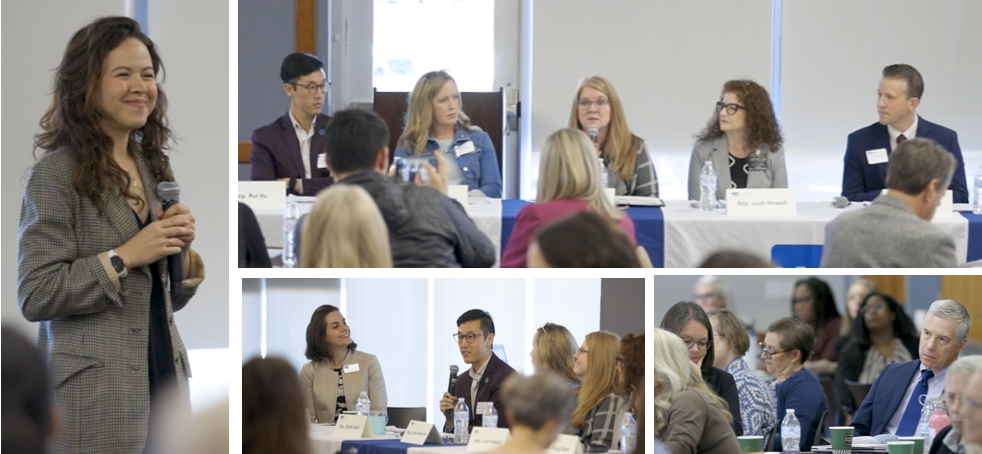
UCS hosted a full room on Wednesday, November 12th at the 2025 Kansas Public Policy Forum, sponsored by REACH Healthcare Foundation, Health Forward Foundation, and United Way of Greater Kansas City. The annual meeting convened more than 100 community members, policymakers, agency partners, and funders at the Matt Ross Community Center in Overland Park.
The event marked the official release of the UCS 2026 Public Policy Platform outlining priority policy issues for the upcoming legislative session.
Opening Data Presentation
To kick off the morning, UCS Executive Director Kristy Baughman provided a data presentation highlighting five-year trends in housing costs in Kansas and in Johnson County with a focus on the loss of affordable rental homes. Baughman then walked through why Kansans should be concerned about rising rent: rental affordability and homeownership are interdependent, with safe, habitable, and stable rental housing as the foundation for future homeownership.
Affordable rents allow community members to invest in education, job training, and transportation; to build credit, relationships, and community ties; and to save for a down payment and prepare for successful long-term investment in homeownership.
Keynote: Buying the Block
The morning continued with a keynote address from Fay Walker, with the LISC Community Research and Impact Team on the recent report: “Buying the Block: The Impact of Corporate Owners on Tenants, and How to Promote Community Accountability”.
Walker provided highlights from this intensive study, including how many rental properties are owned by corporate owners and how many owners are located out-of-state, the impacts of corporate ownerships on housing quality and the rate of evictions, and policy solutions to support renter security and well-being and addressing potential negative consequences of corporate ownership.
Key findings from the report:
- The report defines corporate ownership as more than 100 units
- The highest concentration of out-of-state owners are from California, New York, and Colorado
- On average, corporate landlords have about one and one-half times more maintenance violations than mom and pop landlord owners
- Corporate owners evict renters at about four times the rate of mom-and-pop landlord owners and evict for smaller amounts of money
This results in poorer quality housing for renters and in greater housing churn and costs – for renters, but also for surrounding neighborhoods and the extended community.
Legislative Panel Discussion
Following the keynote presentation, the program featured a panel of Kansas state legislators from both sides of the aisle who are preparing housing legislation for the 2026 legislative session. Moderated by UCS Director of Policy & Planning, Christina Ashie Guidry, the panel included:
- Senator Doug Shane
- Rep. Leah Howell
- Rep. Cyndi Howerton
- Senator Dinah Sykes, Minority Leader
- Rep. Rui Xu
Legislators discussed experiences in their districts related to corporate ownership of single-family and multifamily homes. Rep. Rui Xu noted that the current age of a first-time homebuyer has a hit a high of 40 years old and that corporate purchasing has priced out both Kansans and mom-and-pop landlords. Sen. Doug Shane discussed the condemnation of Aspen Place Apartments in Gardner in May which led to about 700 residents being displaced with just 48 hours’ notice. Sen. Shane found that residents had little or no recourse under the law for getting back security deposit, rent, or recourse for compensation or assistance to find a new place to live.
Panelists stressed that the challenges with rental housing occur throughout the state and require state-wide solutions. Republicans Sen. Shane, Rep. Howell, and Rep. Howerton are focused on legislation that will ensure Kansas are protected from undue harm in housing, that they know who they are getting into business with, and are getting what they pay for. Key provisions include addressing evictions, providing a business registry for rentals, ensuring cities can do inspection of rental properties to ensure renter health and safety, and ensuring that corporate owners set up payment portals to accept full and partial payments.
Republican Priorities (Sen. Shane, Rep. Howell, Rep. Howerton)
Focused on legislation that will ensure Kansans are protected from undue harm in housing, that they know who they are getting into business with, and are getting what they pay for. Key provisions include:
- Addressing evictions
- Providing a business registry for rentals
- Ensuring cities can do inspection of rental properties to ensure renter health and safety
- Ensuring that corporate owners set up payment portals to accept full and partial payments
Democratic Priorities (Sen. Sykes, Rep. Xu)
Focused on helping to support Kansas homes being in Kansas hands, ensuring there are no hidden costs in rental housing, and that Kansans have safe homes. Key provisions include:
- Ensuring all rental fees are disclosed up front
- Capping late fees at 5% and providing a 5-day grace period for rent
- Limiting corporate ownership of single-family homes
- Providing renters and qualifying nonprofits the opportunity to purchase small rental properties going to market sale
Get Involved
If you’re interested in tracking legislation in the upcoming session, you can follow the legislation at KHAN’s website.
If you’d like to connect with legislators on this legislation, email Christina Ashie Guidry: christinag@ucsjoco.org.
UCS Takes Advocacy Academy to Wichita

This month UCS traveled to Wichita to facilitate a two-day Advocacy Academy. Advocacy Academy is part of the Kansas Housing Advocacy Network’s (KHAN) effort to strengthen advocacy across the state. The event in Wichita brought together nonprofit leaders and community advocates from Sedgwick, Douglas, Harvey, Saline, and Lyon counties.
Grounded in the fundamentals of advocacy, participants explored how change often begins with one voice and how effective advocacy requires both issue knowledge and an understanding of decision-makers. They practiced strategic communication—moving audiences from awareness to action—by combining data with compelling personal stories to resonate across divides.
Recognizing that advocacy happens in a divided and often contentious environment, the Academy emphasized the importance of civil discourse. Participants reflected on the ways polarization and assumptions can derail conversations, and then practiced skills to listen with empathy, affirm shared values, and respond in ways that open dialogue rather than close it off.
Panel Discussion with Local Leaders
The Academy closed with a panel discussion featuring local elected officials and government leaders, including:
- Councilmember Mike Hoheisel
- Scott Wadle, Planning Director for Wichita–Sedgwick County
- Sally Stang, Director of the Housing & Community Services Department
When asked how housing advocates can best support affordable housing efforts, their message was clear: show up, advocate, and seize opportunities where your voice can shape the future.
About Advocacy Academy
UCS launched the Advocacy Academy to equip community members, service providers, and local leaders with the tools, data, and confidence they need to advocate for policies that support housing stability, health equity, and strong communities.
As the challenges facing Kansas families continue to grow—rising housing costs, limited rental supply, and increasing pressure on the human service network—effective advocacy has never been more important. The Advocacy Academy provides accessible, nonpartisan training that demystifies the legislative process, strengthens grassroots and grasstops leadership, and builds a statewide network committed to advancing practical, people-centered solutions.
If you would like to learn more about Advocacy Academy, please contact Kristy Baughman: kristyb@ucsjoco.org
Invest in UCS on Giving Tuesday

A gift to UCS fuels the data analysis, community collaboration, and policy leadership that help families stay housed, connect neighbors to essential services, and ensure local decision-making is guided by facts, not assumptions.
In a year marked by uncertainty for households and human service providers, UCS has worked harder than ever to illuminate community needs, bring partners together, and advance practical solutions that prevent crisis before it occurs. Your donation helps us continue this work—supporting initiatives that expand housing stability, strengthen the health and human service network, and center equity in how our community responds to its most pressing challenges.
This Giving Tuesday, invest in the systems that support strong families and thriving communities. Invest in UCS.