HUD CONTINUUM OF CARE GRANT

QUESTIONS?
CONTACT RITA CARR
OVERVIEW
Each year, the U.S. Department of Housing and Urban Development (HUD) offers a national competitive funding opportunity to Continuums of Care (CoCs) working to end homelessness. On June 1st, 2026, HUD released the fiscal year 2026 Notice of Funding Opportunity (NOFO), see NOFO and CoC Program Competition
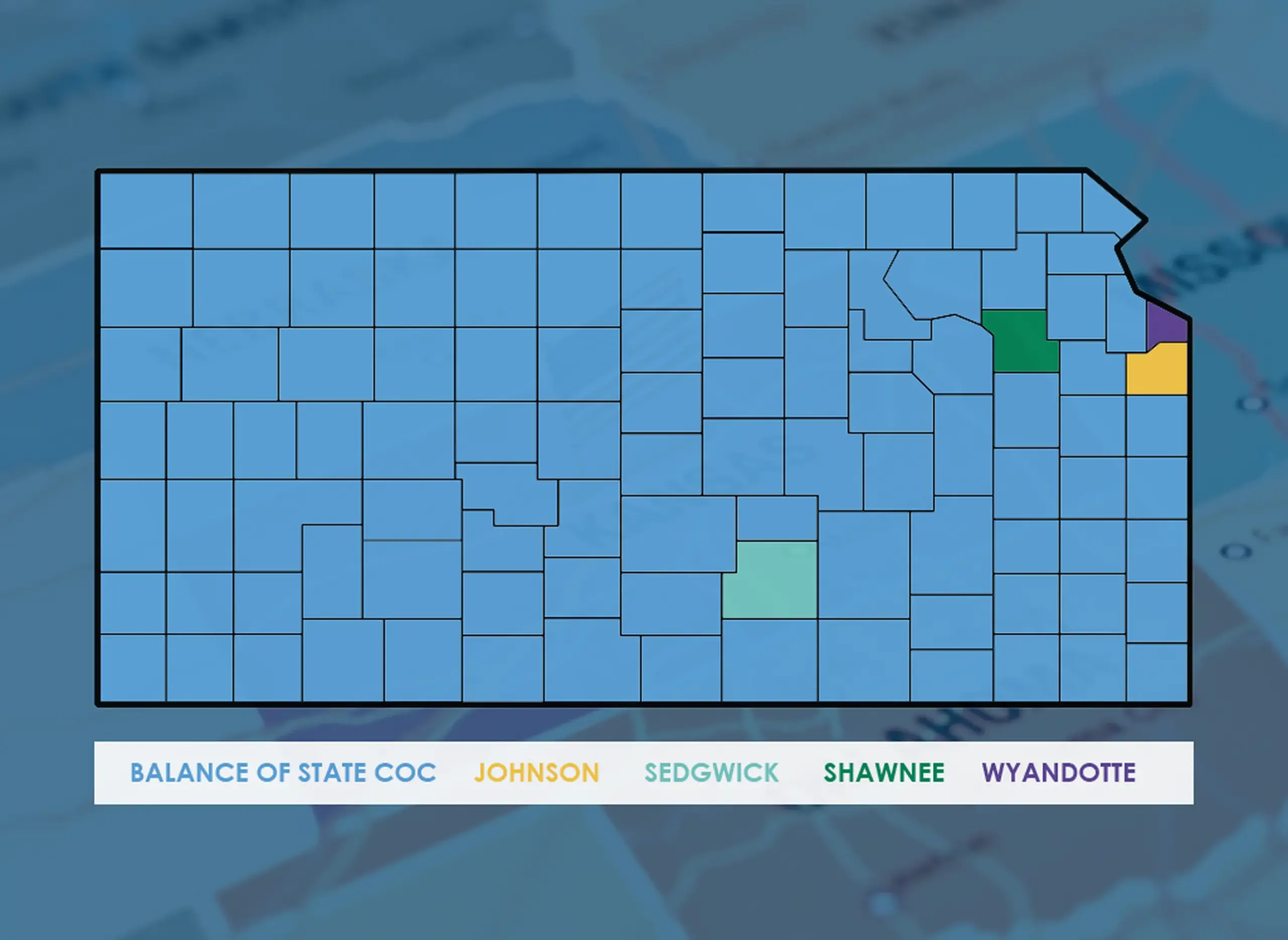
UCS serves as Johnson County’s CoC (KS-505) lead agency and collaborative applicant and submits the application annually on behalf of local members. In fiscal year 2024, $1,061,657 was awarded to members of KS-505’s CoC to support 7 programs in Johnson County offering permanent supportive housing, rapid rehousing, homeless data management services and CoC planning support.
The CoC Program (24 CFR part 578):
- Promotes community-wide commitment to ending homelessness
- Provides funding for nonprofit providers, states, and local governments to quickly re-house homeless individuals, youth, families, and persons fleeing domestic/dating violence, sexual assault, and stalking
- Promotes access to and effective utilization of mainstream programs
- Optimizes self-sufficiency among those experiencing homelessness
KS-505’s FY 2026 Continuum of Care on Homelessness’ Competition
Public Notification for Proposals
**8/11/26 UPDATE: On Monday 8/10/26, HUD sent out a notice stating “Due to the court’s order, the 2026 CoC NOFO and its August 26, 2026, application submission deadline are no longer in force as HUD is unable to accept applications at this time.” The CoC Board voted to pause the KS-505 CoC grant competition until further notice.
When the 2026 Collaborative Application and Priority Listing are ready, they will be posted here by August 21, 2026 prior to submission by August 26, 2026.
Project Applicant Training: June 22, 2026, 2pm- 4pm on zoom. UCS will host a Project Applicant Training for organizations and agencies committed to ending homelessness in Johnson County, KS. To learn about applying for CoC funding, RSVP for the Project Applicant Training, email ritac@ucsjoco.org.
Letter of Intent Deadline: June 24, 2026 by 4pm. Interested applicants must submit a Letter of Intent for each project they are applying for.
- New grant applicants Letter of Intent
- Renewal grant applicants Letter of Intent
Each year the CoC accepts proposals from organizations whether they have previously received funding or not. To join the CoC email list and receive updates on this funding cycle, contact ritac@ucsjoco.org
KS-505 CoC Application Timeline. FY2026 CoC Grant Timeline for the 2026 CoC Application Timeline. The timeline was approved by the KS-505 CoC Board on June 5, 2026. Any necessary updates to the timeline will be subject to CoC Board approval and sent to the CoC email list.
LOCAL APPLICATION DEADLINE: July 27, 2026 by 4pm. Organizations that submit a Letter of Intent will receive the Local Application link by email on 6/25/26. For more information, please contact Rita Carr, ritac@ucsjoco.org .
For more information, please contact Rita Carr, ritac@ucsjoco.org .
Program Description. The Continuum of Care (CoC) Program (24 CFR part 578) is designed to promote a community-wide commitment to the goal of ending homelessness; to provide funding for efforts by nonprofit providers, states, and local governments to quickly re-house homeless individuals, families, persons fleeing domestic violence, dating violence, sexual assault, and stalking, and youth while minimizing the trauma and dislocation caused by homelessness; to promote access to and effective utilization of mainstream programs by homeless individuals and families; and to optimize self-sufficiency among those experiencing homelessness.
Eligible Applicants:
- Nonprofit organizations with 501(c)3 status including faith-based organizations
- State governments, county/city/township governments, and special district governments
- Federal recognized Native American tribal governments
- Native American tribal organizations
- Public housing agencies and Indian housing authorities
New Applicants:
- SAM.gov Registration: You must have an active and up-to-date account with SAM.gov, at the time of application and throughout the life of any award. To register, go to SAM.gov Entity Registration and click “Get Started”. From the same page, you can also click the Entity Registration Checklist for the information you will need to register. It can take several weeks to register in SAM.gov, so get started now if you are planning to apply. SAM.gov also provides each organization with a unique entity identifier (UEI). A valid UEI is required to apply for funding.
- ESNAPS Registration: You must have an active hud.gov account to submit your application. See step-by-step instructions at CoC Program Competition.
Eligible projects in the FY2026 CoC Program Competition are:
- Permanent Supportive Housing
- Rapid Rehousing
- Transitional Housing
- Supportive Services Only
- HMIS
More information about eligible projects and HUD regulations can be found in the CoC Program Interim Rule
For more information on the CoC program components eligible for funding and HUD’s policy priorities, the FY2026 NOFO can be found at NOFO. HUD’s full CoC Program Competition page is CoC Program Competition. CoC- funded projects are expected to meet the KS-505 CoC Written Standards.
CoC Project Application Scoring Tool: The FY2026 KS-505 CoC Grant scoring tools can be found here. The Committee is made up of CoC members who are not representatives of organizations competing for funding. They will be required to evaluate applications, review project performance, and make recommendations on project application rank order and final funding requests as consistent with HUD guidelines.
Reallocation: KS-505 regularly reviews the performance of CoC funded programs to assure that they meet the needs of residents experiencing homelessness, result in successful and sustainable permanent housing, and that awarded funding is spent down in a timely manner so that funds are not returned unspent. KS-505 members work together to support the success of CoC-funded programs. However, under certain circumstances HUD CoC funding may be recommended for reallocation due to a number of factors. For more information, see KS-505 CoC Grant Competition & Reallocation Policies.